September and October can combine several driving conditions that require added care from commercial truck drivers and other motorists in Massachusetts. Shorter daylight, low-angle sun, rain, fog, wet leaves, school-year traffic, construction activity, and changing commute patterns can reduce visibility and stopping margins. Large trucks need more time and space to slow, turn, merge, and react than passenger vehicles, so changing road conditions can become more serious around a tractor-trailer, box truck, dump truck, or delivery vehicle.
Hoey Law represents injured people and families in Massachusetts and helps them understand the evidence, insurance issues, and legal questions that can follow a serious truck crash.
A fall truck crash is not automatically caused by weather or seasonal conditions. A collision may involve driver error, fatigue, unsafe speed, mechanical problems, poor maintenance, cargo issues, roadway conditions, another motorist, or several factors at once. The season can affect driving conditions, but fault must be determined from the evidence.
Fall weather does not decide fault. The evidence from the crash determines responsibility.
For information about Massachusetts car accident claims, visit:
https://www.lawhoey.com/massachusetts-car-accident-lawyer/
Why Fall Driving Can Be Harder for Commercial Trucks 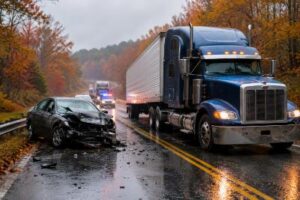
Massachusetts traffic patterns change after the summer. School buses return to regular routes, parents resume school drop-off and pickup routines, and commuter traffic can become more concentrated during morning and afternoon periods.
Commercial trucks have less room for sudden changes in traffic. A tractor-trailer needs more stopping distance than a passenger vehicle and requires extra space for turns and lane changes. If a truck driver follows too closely, travels too fast for conditions, or enters congestion without enough space, the driver may have fewer options when traffic suddenly slows.
The Federal Motor Carrier Safety Administration explains that large trucks and buses have large blind spots, long stopping distances, and wide-turn requirements:
https://www.fmcsa.dot.gov/ourroads/tips-driving-safely-around-large-trucks-or-buses
Shorter Days and Low-Angle Sun Can Reduce Visibility
Daylight decreases through September and October. Morning and evening travel can also place the sun low on the horizon.
Low-angle glare can make brake lights, lane markings, traffic signals, pedestrians, cyclists, and smaller vehicles harder to see. A commercial truck also has larger blind areas than a typical passenger vehicle. When glare, shadows, or dusk combine with those blind spots, the time available to recognize a hazard can shrink.
When you drive near a large truck, avoid remaining beside the cab or trailer for longer than necessary. If you cannot see the truck driver in a mirror, the driver may not be able to see you.
Rain, Fog, and Wet Leaves Can Affect Stopping and Traction
Fall weather in Massachusetts can change quickly. Rain can reduce visibility and tire grip. Fog can make distance harder to judge. Wet leaves can reduce traction and may cover lane markings, potholes, or standing water.
Large commercial vehicles already need substantial stopping space. When roads are wet or visibility is limited, safe operation may require lower speeds, greater following distance, earlier braking, and more cautious lane changes.
Rain, fog, or leaves do not automatically excuse a crash. Drivers still need to respond reasonably to the conditions they encounter. If a truck driver continues at an unsafe speed or fails to leave enough room to stop, those choices may become important when determining negligence.
Back-to-School Traffic Creates More Conflict Points
September brings more school buses, student drivers, pedestrians, bicyclists, crossing activity, and parent traffic to Massachusetts roads. Commercial routes can overlap with those same morning and afternoon travel periods.
Common fall conflict points can include:
- Sudden stops near schools and intersections
- Passenger vehicles merging around buses or delivery trucks
- Trucks making wide right turns
- Vehicles entering or leaving parking lots
- Pedestrians entering crossings
- Drivers changing lanes around slower traffic
- Backing movements near businesses and loading areas
A truck driver must account for the size, stopping distance, blind spots, and turning path of the vehicle. You should also avoid cutting closely in front of a large truck or remaining in an area where the truck driver may not be able to see your vehicle.
Construction Can Continue Into the Fall
Road construction and maintenance projects may continue through September and October in Massachusetts. Work zones can include lane shifts, narrowed lanes, temporary barriers, reduced shoulders, uneven pavement, and sudden merge points.
A work zone can give a commercial truck less room to recover from a mistake. A truck that drifts within a narrowed lane or enters a merge too quickly can create a sideswipe, rear-end, or multi-vehicle crash risk.
A work-zone collision may also require review of lane markings, warning signs, traffic-control plans, contractor activity, vehicle speed, and the conduct of other drivers.
Why Truck Accident Claims Often Require More Evidence
A commercial truck collision can involve more records and potentially responsible parties than a typical two-car crash. The driver may work for a motor carrier. The tractor and trailer may have different owners. A separate company may have loaded the cargo. Maintenance work may have been performed by an outside contractor.
Evidence that may become relevant includes:
- Electronic logging device data
- Event data recorder or engine control information
- GPS and dispatch records
- Driver qualification and training records
- Inspection and maintenance records
- Brake and tire records
- Cargo loading and securement records
- Dash-camera footage
- Post-crash inspection documents
- Witness statements
- Traffic, business, or roadway video
Some evidence may not remain available indefinitely. Prompt preservation can matter when vehicles are repaired, electronic data is overwritten, or commercial video systems delete older footage.
Who May Be Responsible for a Massachusetts Truck Crash?
Liability depends on what caused the collision. A truck driver may be responsible when speeding, distraction, fatigue, an unsafe lane change, following too closely, or failure to adjust to road and traffic conditions contributes to the crash.
A trucking company may face responsibility if its own conduct contributed to the collision, including negligent hiring, inadequate supervision, unsafe scheduling, or poor maintenance practices. Depending on the facts, other potentially responsible parties may include a trailer owner, maintenance contractor, cargo loader, parts manufacturer, roadway contractor, or another driver.
Massachusetts follows a modified comparative negligence rule. You may recover damages if your negligence was not greater than the total negligence of the person or people from whom you seek recovery. Any recovery is reduced by your percentage of fault.
Massachusetts General Laws, Chapter 231, Section 85:
https://malegislature.gov/Laws/GeneralLaws/PartIII/TitleII/Chapter231/Section85
What Damages May Be Available After a Truck Accident?
A truck accident claim may involve immediate and long-term losses. Depending on the facts, available insurance, and the evidence, recoverable damages may include:
- Medical expenses
- Lost income
- Reduced earning capacity
- Pain and suffering
- Disability
- Scarring
- Rehabilitation costs
- Other documented losses related to the injury
Massachusetts Personal Injury Protection, often called PIP, may apply to certain medical expenses, lost wages, and replacement services. Massachusetts PIP generally provides benefits up to $8,000 per person, subject to policy terms, health insurance coordination rules, and deductible choices. PIP can also cover up to 75 percent of certain lost wages, subject to applicable rules and limits.
Massachusetts auto insurance information:
https://www.mass.gov/info-details/part-ii-what-is-in-my-insurance-policy
Serious truck crashes can involve several insurance policies at the same time. Determining which policy applies and whether another source of coverage exists may require review of the truck, trailer, employer, contractor, and other available insurance information.
What Should You Do After a Fall Truck Accident?
Your first priority is safety and medical care. Call 911 when someone is injured, traffic is blocked, or the scene remains dangerous.
If your condition allows, preserve information without putting yourself at additional risk:
- Photograph the vehicles, roadway, debris, lane markings, weather, and lighting
- Record the truck company name, license plate, and identifying numbers if visible
- Get witness names and contact information
- Save dash-camera footage
- Keep towing, repair, rental, medical, and wage records
- Avoid guessing about speed, distance, or fault when speaking with an insurer
- Do not sign a broad settlement release until you understand which rights the release may end
Massachusetts generally requires a Motor Vehicle Crash Operator Report within five days when a crash causes injury, death, or more than $1,000 in damage to any one vehicle or other property. A copy must also be sent to the police department with jurisdiction over the location of the crash.
Massachusetts crash-report requirements:
https://www.mass.gov/how-to/report-a-motor-vehicle-crash
How Long Do You Have to File a Massachusetts Truck Accident Claim?
Massachusetts generally gives you three years to file many personal injury lawsuits. Different rules or shorter notice periods can apply depending on the facts, the parties involved, and the type of claim.
Massachusetts General Laws, Chapter 260, Section 2A:
https://malegislature.gov/laws/generallaws/partIII/titleV/chapter260/section2A
The lawsuit deadline is not the only reason to act promptly. Evidence can disappear well before the filing deadline. Road conditions change, damaged vehicles are repaired, witnesses become harder to locate, and commercial records may be kept for limited periods.
How Legal Representation Can Help After a Truck Crash
A Massachusetts truck accident attorney can investigate the collision, identify potentially responsible parties, send evidence-preservation requests, review insurance coverage, collect medical and wage documentation, address comparative-fault arguments, and prepare the claim for negotiation or litigation when necessary.
You can learn more about David J. Hoey and the legal team at:
You can review representative verdicts and settlements at:
https://www.lawhoey.com/verdicts-and-settlements
Past results do not predict the outcome of a future case.
You can read additional legal updates at:
https://www.lawhoey.com/newsroom
Speak With a Massachusetts Truck Accident Attorney
A fall truck crash can leave you managing medical treatment, missed work, vehicle damage, and insurance questions at the same time. Hoey Law can review the circumstances of the collision, explain the Massachusetts claim process, and help identify evidence and insurance coverage that may affect your case.
David J. Hoey has handled complex civil litigation and catastrophic injury matters since 1997. Hoey Law represents injured people and families in Massachusetts and nearby areas.
Call (978) 662-8868 or request a consultation at:
https://www.lawhoey.com/contact-us
This article is for informational purposes only and is not legal advice. Consult an attorney about your specific situation.