Yes. If you are struck by a vehicle near a Massachusetts school zone, you may be able to file an injury claim when another person or organization acted negligently and caused the collision. The school-zone location does not establish fault by itself. School-zone speed rules, crosswalk activity, school-bus traffic, crossing guards, visibility, driver attention, and traffic conditions can all become important evidence.
Hoey Law helps injured people and families across Massachusetts understand how fault, insurance, damages, and filing deadlines may apply after a pedestrian accident. School-area crashes can involve children, parents, teachers, crossing guards, bus drivers, delivery vehicles, contractors, and other people sharing a crowded area during arrival and dismissal times.
A careful claim review should identify who controlled the vehicle or location, which safety rules applied, what evidence exists, and whether a public entity, employer, property owner, or transportation contractor may be involved.
For more information about pedestrian injury claims, visit:
https://www.lawhoey.com/massachusetts-pedestrian-accident-lawyer/
Can You File a Pedestrian Accident Claim Near a Massachusetts School? 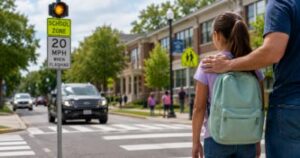
You can often pursue a pedestrian accident claim when a driver failed to use reasonable care and that failure caused your injuries. Examples can include a driver who:
- Drove too fast for crowded school-area conditions
• Failed to yield when required
• Turned through a pedestrian path without checking for people in the roadway
• Backed out of a pickup or parking area without seeing a pedestrian
• Used a phone or became distracted while driving
• Failed to slow for a special hazard involving pedestrians or traffic
Massachusetts law provides that driving faster than 20 miles per hour within a properly established school zone can be prima facie evidence that the speed was greater than reasonable and proper. Drivers must also use a speed that is reasonable and proper for traffic, use of the roadway, public safety, pedestrian activity, weather, and road conditions. A posted speed can still be too fast for the circumstances when children are close to the roadway, parked vehicles block sight lines, a crossing guard is present, or traffic is stopping suddenly.
Massachusetts also follows a modified comparative negligence rule. If an injured pedestrian shares some responsibility for the accident, compensation can be reduced by the pedestrian’s percentage of fault. Recovery is generally barred when the pedestrian’s negligence is greater than the total negligence attributed to the person or people from whom recovery is sought.
The strongest school-zone pedestrian claims are built from evidence, not assumptions.
The location can help explain why a driver should have anticipated pedestrians, but the claim still depends on what happened before the impact and whether negligent conduct caused the injury.
What Evidence Can Show Driver Negligence?
School-area crashes can produce several types of useful evidence. Some sources can disappear quickly because buses leave, pickup traffic clears, camera systems overwrite recordings, and witnesses continue with their day.
Evidence may include:
- Police reports and crash diagrams
• Photographs of the crosswalk, roadway, signs, school entrance, parked vehicles, and vehicle positions
• School-bus or transportation-company camera footage
• Video from nearby homes, businesses, school property, or municipal cameras
• Dash camera recordings
• Witness statements from parents, staff members, crossing guards, students, or other drivers
• Vehicle data and damage patterns
• Cell phone records or other electronic evidence obtained through lawful procedures
• Medical records showing the timing, diagnosis, treatment, and extent of the injuries
A prompt investigation can be especially useful when visibility is disputed. A driver may say that a child or adult entered the road from between parked vehicles. Photographs, witness accounts, video, roadway measurements, lighting conditions, and evidence of vehicle speed may help show what the driver could see and whether there was enough time or distance to react.
Does It Matter If the Injured Pedestrian Is a Child?
Yes. A pedestrian accident involving a child requires careful analysis of the child’s age, conduct, surroundings, and ability to understand traffic risks. An insurer may argue that the child entered the roadway unexpectedly or crossed outside a marked crosswalk, but those facts must be considered with the rest of the evidence.
Drivers approaching a school entrance, crosswalk, bus stop, or crowded pickup area should account for children, changing traffic patterns, limited sight lines, and sudden stops. The surrounding conditions may affect what reasonable driving required at that moment.
Parents should focus on preserving evidence and obtaining medical care rather than debating fault before the facts are known. Video, photographs, witness statements, vehicle data, and roadway measurements can help show what the child saw, what the driver saw, how fast the vehicle was moving, and whether anything blocked the view.
Who May Be Responsible Besides the Driver?
The driver is often the primary focus, but some school-zone pedestrian claims involve more than one potentially responsible party. Depending on the facts, a claim may involve:
- A vehicle owner
• An employer whose employee was driving for work
• A school-bus or transportation contractor
• A transportation company
• A property owner
• A municipality or other public employer
• Another organization whose conduct contributed to the collision
A school, municipality, or public agency is responsible only when the evidence and applicable law connect that entity, its employee, its vehicle, or a condition within its legal responsibility to the accident.
Claims involving public entities can follow different procedures. Under the Massachusetts Tort Claims Act, a claim against a public employer generally requires written presentment to the proper executive officer within two years after the cause of action arose. A civil action generally must be brought within three years.
A claim based on a defect in a public way can have a much shorter notice period. Massachusetts law generally requires written notice within 30 days for a covered claim under the public-way defect statute. The correct deadline depends on the defendant and legal theory, so an early review can help protect the claim.
For information about Hoey Law’s attorneys, visit:
https://www.lawhoey.com/our-team/
For prior case results, visit:
https://www.lawhoey.com/results/
Past results do not guarantee a similar outcome. Every case depends on its own facts and circumstances.
What Insurance May Apply After a Pedestrian Accident?
A pedestrian struck by a motor vehicle may have access to more than one source of insurance, depending on the circumstances.
Massachusetts Personal Injury Protection, or PIP, can cover pedestrians struck by an insured motor vehicle. PIP can provide up to $8,000 per person for covered losses, subject to the policy terms and applicable health-insurance rules. Covered losses can include reasonable and necessary medical expenses, up to 75 percent of certain lost wages, and qualifying replacement services.
A separate bodily injury liability claim may be available when another driver’s negligence caused the collision and the legal requirements are met.
Coverage can become more involved when the vehicle is uninsured, underinsured, owned by a business, operated by a government employee, or connected to a school transportation contractor. Vehicle ownership, the driver’s work status, policy terms, household coverage, and other available insurance can affect the analysis.
For broader information about Massachusetts motor vehicle injury claims, visit:
https://www.lawhoey.com/massachusetts-car-accident-lawyer/
Before signing a settlement release, make sure you understand which claims and parties the release covers. A settlement should be evaluated in light of supported losses that can include future treatment, rehabilitation, missed school or work, reduced earning capacity, scarring, lasting physical limitations, and other documented harm.
What Compensation May Be Available?
The value of a pedestrian accident claim depends on the injuries, medical evidence, fault, available insurance, and the effect of the injury on daily life. A supported claim may seek compensation for losses such as:
- Emergency care, hospitalization, surgery, therapy, medication, and future treatment
• Lost wages and reduced earning capacity
• Pain and suffering when the legal requirements are met
• Physical limitations, scarring, disability, and loss of normal activities
• Transportation expenses and other documented out-of-pocket costs
• Future care or support needs when supported by medical evidence
Massachusetts has a statutory threshold for recovering pain and suffering damages in many motor vehicle injury cases. In general, the plaintiff must have more than $2,000 in reasonable and necessary medical expenses unless an exception applies. Exceptions include death, loss of a body member, permanent and serious disfigurement, certain loss of sight or hearing, or a fracture.
The medical evidence and facts should be reviewed before a settlement is accepted.
What Should You Do After a School-Zone Pedestrian Accident?
Your first priority is medical care and immediate safety. Call 911 when someone may be injured, follow instructions from emergency personnel, and move a seriously injured person only when an immediate danger makes movement necessary.
When you can act safely:
- Photograph the roadway, crosswalks, signs, signals, parked vehicles, vehicle damage, and visible injuries
• Get witness names and contact information
• Note nearby cameras, school buses, homes, businesses, and public buildings that may have recorded the scene
• Preserve clothing, damaged personal items, photographs, and other physical evidence
• Keep medical records, discharge instructions, wage information, transportation receipts, and insurance correspondence together
• Write down what you remember while the details are still fresh
Avoid detailed social media posts about the crash, your injuries, or your activities during recovery. When communicating with an insurer, provide accurate information and avoid guessing about speed, distance, visibility, or facts that you do not remember clearly.
How Long Do You Have to File a Pedestrian Accident Claim in Massachusetts?
Many Massachusetts personal injury lawsuits are generally subject to a three-year limitations period. Special rules can apply when the injured person is a minor, a public employer is involved, or the claim concerns a defect in a public way.
Massachusetts law generally tolls certain limitations periods for a person who was a minor when the right to bring the action first accrued. Claims involving public employers can require written presentment within two years. Covered public-way defect claims can require notice within 30 days.
The legal deadline is only one timing issue. School-zone cases often depend on camera footage and witness evidence that can be lost within days or weeks. Preserving that material early can be critical to the claim.
How Can a Massachusetts Pedestrian Accident Lawyer Help?
A Massachusetts pedestrian accident lawyer can investigate the crash, identify potential defendants, preserve video and records, review insurance coverage, organize medical and wage documentation, communicate with insurers, address comparative fault arguments, and prepare the claim for negotiation or litigation.
A lawyer can also determine whether special rules apply because a child, public employer, school transportation contractor, business vehicle, uninsured driver, or roadway condition is involved.
For more legal updates from Hoey Law, visit:
Speak With a Massachusetts Pedestrian Accident Lawyer
If you or your child was injured by a vehicle near a Massachusetts school, Hoey Law can review the circumstances, explain which insurance and filing rules may apply, and discuss evidence that may need to be preserved.
Attorney David J. Hoey has handled complex civil litigation and catastrophic injury matters since 1997. Hoey Law represents injured people and families across Massachusetts and handles personal injury matters involving motor vehicle crashes and other negligence claims.
Call (978) 662-8868 to discuss your situation, or visit:
https://www.lawhoey.com/contact-us/
Every case depends on its own facts, and no particular result can be promised.
This article is for informational purposes only and is not legal advice. Consult an attorney about your specific situation.