Yes. A deer-related car accident can be covered by insurance in Massachusetts, but the coverage that applies depends on how the crash happened and what you purchased before the accident.
If your vehicle directly strikes a deer, Comprehensive coverage is generally the part of an auto policy that pays for covered damage to your own vehicle, subject to the policy terms and deductible. If you swerve to avoid a deer and hit a guardrail, tree, another vehicle, or another object, Collision coverage may apply to the damage to your vehicle. If you are injured, Massachusetts Personal Injury Protection, or PIP, may help pay covered medical expenses, certain lost wages, and replacement services.
Hoey Law helps Massachusetts drivers address insurance and injury issues after serious crashes. A deer collision can raise questions about vehicle damage, medical bills, towing, rental expenses, total-loss value, and whether another driver contributed to the accident. The firm is based in North Reading, Massachusetts, and handles personal injury and car accident matters throughout the Commonwealth.
Are Deer Accidents Covered by Comprehensive Insurance in Massachusetts? 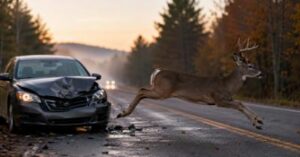
In many cases, yes. Massachusetts insurance guidance identifies contact with a bird or animal as a type of loss that Comprehensive coverage can cover. Comprehensive is optional coverage for direct and accidental damage to your vehicle caused by events other than a traditional collision.
If you hit a deer directly and you purchased Comprehensive coverage before the crash, that coverage is generally the first place to look for payment for covered vehicle damage. Your deductible still applies. If the repair cost is below or only slightly above the deductible, your insurer may pay little or nothing toward the repair.
Comprehensive coverage is not one of the compulsory coverages every Massachusetts driver must purchase. If you carry only the required coverages, you may have no first-party coverage for damage to your own vehicle after a direct deer strike.
A direct strike with a deer is generally treated differently from a crash caused by swerving and hitting another object.
What Is the Difference Between Comprehensive and Collision Coverage?
The crash sequence can determine which coverage applies.
- Direct contact with a deer is generally handled under Comprehensive coverage.
- Hitting a guardrail, tree, pole, another vehicle, or another object after swerving is generally handled under Collision coverage.
- A crash with multiple impacts may require the insurer to review photographs, repair estimates, witness information, and the police report before deciding how to classify each part of the loss.
For example, if a deer runs onto a road near North Reading and your vehicle strikes the animal, Comprehensive coverage is generally the relevant coverage for your vehicle damage. If you avoid the deer but hit a guardrail, Collision coverage may be the relevant coverage.
Massachusetts does not require drivers to purchase Comprehensive or Collision coverage. A lender may require both coverages while a vehicle is financed.
What If You Only Have the Required Massachusetts Auto Insurance?
Massachusetts requires several basic auto insurance coverages, but those compulsory coverages do not pay for every type of damage to your own vehicle. The required policy includes coverage for certain bodily injuries, PIP benefits, uninsured motorist bodily injury protection, and damage you cause to someone else’s property.
If a deer damages your vehicle and you do not have Comprehensive coverage, your required insurance may not pay to repair or replace your vehicle. If you swerve and hit another object but did not purchase Collision coverage, you may face the same problem with your own vehicle damage.
Review your policy declarations page instead of relying on the phrase “full coverage.” Look for:
- Comprehensive coverage and its deductible
- Collision coverage and its deductible
- Rental reimbursement
- Towing and labor coverage
- Medical Payments coverage
- Loan or lease coverage, when applicable
What Insurance Pays If You Are Injured in a Deer Collision?
Vehicle damage and injury benefits are separate insurance issues. Massachusetts PIP can provide up to $8,000 per person for covered benefits after an auto accident. Depending on the circumstances, those benefits can include reasonable and necessary medical expenses, certain lost wages, and replacement services. Health insurance coordination rules can affect how medical bills are submitted and paid.
Optional Medical Payments coverage may provide another source of payment for certain medical expenses after applicable PIP benefits. Health insurance may also become involved based on the treatment, the PIP payment sequence, and the terms of the health plan.
A direct collision with a deer does not create a negligence claim against the animal. If no other person contributed to the crash, there may be no negligent driver or other responsible person from whom you can seek damages for pain and suffering.
What If Another Driver Is Involved?
A deer-related crash can become a liability case when another driver’s conduct contributes to the collision or your injuries. For example, another driver may stop abruptly, cross the center line, make an unsafe lane change, or swerve into your vehicle while reacting to wildlife.
The deer may have triggered the emergency, but the conduct of each driver still matters. Evidence can include:
- Vehicle positions and points of impact
- Skid marks or braking information
- Road and lighting conditions
- Witness observations
- Dash-camera footage
- Photographs and video from the scene
- The timing and sequence of each impact
- Police reports and other crash records
If another driver is legally responsible for your injuries, bodily injury liability coverage may become relevant. Uninsured or underinsured motorist coverage may also matter in some injury claims when the responsible driver has no insurance or does not have enough insurance.
Do You Have to Report a Deer Accident in Massachusetts?
Massachusetts requires an operator crash report when a motor vehicle crash causes an injury, a death, or more than $1,000 in damage to any one vehicle or other property. The report must generally be filed within five days with the Registry of Motor Vehicles. A copy must also be sent to the police department with jurisdiction over the location of the crash and to the insurer.
MassWildlife advises drivers to report deer and moose vehicle collisions to the Massachusetts Environmental Police. If anyone is injured, your vehicle is disabled in a dangerous location, or the animal creates an immediate roadway hazard, call 911 and follow the directions of emergency responders.
Why Fall Deer Collisions Deserve Extra Attention
Deer are active throughout the year in Massachusetts, but fall creates a higher seasonal risk. White-tailed deer breed from late October through early December and are especially active around dawn and dusk.
MassDOT data cited by MassWildlife shows that 48% of reported deer and moose vehicle collisions from 2018 through 2022 occurred from October through December. November alone accounted for 25% of the reported collisions during that period.
Lower light, roadside vegetation, and sudden animal movement can leave little time to react. MassWildlife advises drivers not to swerve to avoid a deer because swerving can create a greater risk of a second collision.
What Should You Do After Hitting a Deer?
After a deer collision, focus on safety, medical needs, and documentation. When you can do so safely:
- Move out of active traffic if the vehicle can be moved safely.
- Check yourself and your passengers for injuries.
- Call 911 when someone is injured, the vehicle is in a dangerous position, or the animal creates a roadway hazard.
- Do not approach an injured deer.
- Photograph the vehicle damage, roadway, surrounding area, and visible debris.
- Record the time, exact location, direction of travel, weather, lighting, and what you observed before impact.
- Preserve dash-camera footage and witness contact information.
- Notify your insurer promptly and ask which coverage is being opened.
- Keep repair estimates, towing bills, rental expenses, medical records, and insurance correspondence.
- Complete any required Massachusetts crash report within five days.
When you speak with an insurer, provide the facts you know. Do not guess about speed, distance, timing, or other details that you cannot accurately recall.
Can an Insurance Company Deny or Reduce a Deer Accident Claim?
Yes. A claim can be disputed even though deer collisions are generally insurable under the appropriate coverage.
An insurer may determine that:
- You did not purchase the coverage needed for the type of loss.
- Your deductible is greater than or close to the covered repair cost.
- The claimed damage resulted from an excluded event.
- Some of the claimed damage existed before the crash.
- Repair methods or replacement parts are disputed.
- The vehicle’s actual cash value is disputed after a total loss.
- Storage, towing, or rental expenses exceed the applicable coverage.
- The loss should be handled under Collision rather than Comprehensive coverage, or the reverse.
Keep your declarations page, photographs, repair documents, towing records, medical records, and written claim communications. If coverage is denied, ask the insurer to provide the decision and the policy basis in writing.
How Can a Massachusetts Car Accident Attorney Help?
Many deer strikes involve property damage only. Legal representation may become more relevant if you suffer serious injuries, another driver is involved, fault is disputed, or several insurance policies may apply.
A Massachusetts car accident attorney can review:
- How the crash happened
- Available auto insurance coverage
- Medical records and bills
- Lost income and work restrictions
- Photographs and video
- Witness statements
- Police and crash reports
- Insurance correspondence
- Whether another person or entity may be legally responsible
An attorney can also help separate first-party insurance issues, such as Comprehensive, Collision, and PIP benefits, from any negligence claim that may exist against another driver or responsible party.
You can learn more about the attorneys at Hoey Law:
You can review reported verdicts and settlements:
https://www.lawhoey.com/verdicts-and-settlements
Past results do not predict the outcome of a future case.
You can also review legal updates from the firm:
https://www.lawhoey.com/newsroom
Talk With a Massachusetts Car Accident Attorney About a Deer Crash
If you were injured in a deer-related car accident in Massachusetts, Hoey Law can review the crash, available insurance coverage, medical issues, and any involvement by another driver. Attorney David J. Hoey and the firm have more than 30 years of experience representing people in serious personal injury and negligence matters.
Call Hoey Law at (978) 662-8868
https://www.lawhoey.com/contact-us
This article is for informational purposes only and is not legal advice. Every case is different. Consult an attorney about your specific situation.