Witness accounts can help counter bias against motorcyclists in Massachusetts by providing independent evidence about how an accident occurred. When drivers, insurance adjusters, or other parties assume that a motorcyclist was speeding or behaving recklessly, eyewitness testimony can clarify vehicle movements, traffic signals, and the actions that caused the collision. Under Massachusetts General Laws Chapter 231, Section 85, a motorcyclist’s percentage of fault can affect the compensation available after an accident. Hoey Law helps injured motorcyclists evaluate evidence, address disputed liability, and pursue fair consideration of their claims.
Why Motorcyclists May Face Unfair Assumptions After an Accident
Motorcycle accidents often involve more than physical injuries. Injured riders may also face assumptions about their behavior before anyone has carefully examined the evidence.
Some observers may associate motorcycles with excessive speed, aggressive driving, or unnecessary risk-taking. These perceptions can influence how witnesses describe an accident, how drivers explain their actions, and how insurance companies initially evaluate responsibility.
A driver who failed to notice an approaching motorcycle might claim that the rider appeared suddenly or must have been traveling too fast. Without independent evidence, that explanation could become a central part of the insurance investigation.
Yet motorcycle ownership does not establish negligence. Like other motorists, riders are entitled to have their actions evaluated according to the available facts and applicable Massachusetts traffic laws.
A Massachusetts motorcycle accident attorney can help identify whether assumptions about motorcycle riding are influencing an accident claim and investigate the evidence needed to address them.
How Witness Accounts Help Establish What Actually Happened
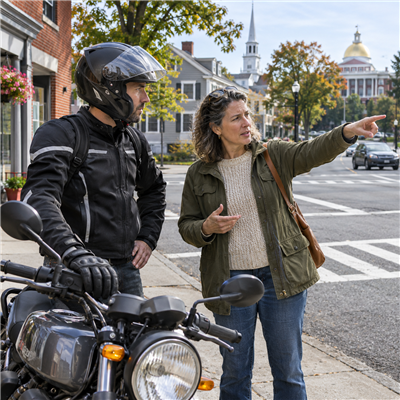
Independent witnesses can provide an account of the moments before, during, and immediately after a motorcycle collision.
Unlike the drivers directly involved, an unrelated observer may have no personal financial interest in the outcome. This independence can make a witness particularly helpful when the parties disagree about responsibility.
For example, a driver might claim that a motorcycle approached an intersection at excessive speed. A pedestrian who observed the collision could explain that the motorcycle was traveling with surrounding traffic and that the driver turned across its path.
Such testimony does not automatically establish liability. It provides factual information that investigators, insurers, and potentially a jury can evaluate alongside other evidence.
Witnesses may help clarify:
- Whether the motorcycle had the right of way.
- Whether a driver failed to yield before turning.
- Whether either vehicle entered an intersection against a traffic signal.
- Whether the motorcyclist was maintaining a consistent lane position.
- Whether a driver appeared distracted before the collision.
- Whether braking, evasive movement, or other actions occurred immediately before impact.
Specific observations can be more useful than broad opinions about which driver seemed responsible.
Key point: An independent witness can help establish what happened. A witness statement does not automatically prove fault.
The Role of Witness Testimony in Massachusetts Comparative Negligence Cases
Massachusetts follows a modified comparative negligence system under Massachusetts General Laws Chapter 231, Section 85.
An injured motorcyclist generally may recover damages when their share of negligence is not greater than the combined negligence of the parties against whom recovery is sought. If the motorcyclist is found partially responsible, their compensation is reduced according to their percentage of fault.
Consider a hypothetical accident in which a rider suffers $200,000 in legally recoverable damages.
If the rider is determined to be 20% responsible, the damages would be reduced to $160,000. In a case involving one defendant, the rider may generally recover if found 50% or less at fault, with damages reduced by that percentage. If the rider is found more than 50% at fault, recovery would generally be barred.
These calculations demonstrate why determining fault accurately matters.
Suppose an insurance company initially argues that a motorcyclist was speeding. An independent witness might explain that the rider was traveling normally when another vehicle made an unexpected left turn.
That evidence could challenge the insurer’s proposed allocation of responsibility.
Witness testimony cannot eliminate genuine negligence by a rider. Its value comes from helping ensure that responsibility reflects actual conduct rather than assumptions associated with motorcycles.
Which Types of Witnesses Can Strengthen a Motorcycle Accident Claim?
Not all witnesses observe the same details. Different perspectives may help establish separate elements of an accident.
Independent Bystanders
Pedestrians, nearby residents, and people waiting at intersections may observe vehicle movements without being directly involved.
Their statements can be valuable when they clearly describe where they were standing, what they saw, and how much of the collision they witnessed.
Other Drivers
Motorists traveling behind or beside a motorcycle may be able to describe lane positioning, speed relative to traffic, signaling, and the actions of another driver.
A driver following the motorcycle could also explain whether the rider had sufficient time to avoid the collision.
Nearby Business Employees
Employees working near an accident scene may observe traffic conditions or the sequence of events.
Some businesses also maintain surveillance cameras. Witness statements can help identify potentially relevant recordings before they are overwritten.
Passengers
Motorcycle passengers and occupants of other vehicles may provide useful information, although their relationships with those involved can affect how their testimony is evaluated.
A witness does not have to be completely independent to provide relevant evidence. Credibility depends on several factors, including consistency, opportunity to observe, and potential bias.
How Witness Statements Can Challenge Common Motorcycle Accident Misconceptions
Several recurring assumptions can affect motorcycle accident investigations.
“The Motorcyclist Must Have Been Speeding”
Motorcycles can appear to approach quickly because of their smaller visual profile and the difficulty some observers experience when estimating speed.
A witness who observed both vehicles before the collision may help establish their relative movements.
Even then, precise speed estimates may require video footage, physical evidence, or accident reconstruction analysis.
“The Rider Appeared Out of Nowhere”
This statement sometimes follows collisions involving drivers who turned or changed lanes without recognizing a motorcycle.
A witness may explain that the motorcycle was visible for several seconds before the impact.
Such observations can help investigators examine whether the other driver maintained an adequate lookout.
“Motorcyclists Always Take Greater Risks”
Generalizations about riding behavior do not establish what happened in a particular accident.
Witness testimony describing proper signaling, ordinary traffic movement, and reasonable evasive action can help distinguish the rider’s actual conduct from stereotypes.
The central question remains whether either party acted negligently and whether that negligence caused the injuries.
What Makes a Witness Statement Credible?
Insurance companies and courts do not treat every statement as equally persuasive.
A credible witness should describe direct observations accurately without filling gaps with speculation.
Several factors can influence the weight of testimony:
- Visibility: Whether the witness had an unobstructed view of the accident.
- Distance: How far the witness was from the vehicles.
- Attention: Whether the witness observed the events before the collision or noticed only the impact.
- Consistency: Whether the account remains reasonably consistent over time.
- Independence: Whether the witness has a relationship or interest that could affect their account.
- Supporting evidence: Whether photographs, videos, vehicle damage, or other records support the observations.
An account containing uncertainty can still be credible. A witness who acknowledges not seeing a traffic signal may be more reliable than someone who confidently describes details outside their field of vision.
Attorneys can examine these issues when evaluating testimony and preparing a motorcycle accident claim.
How to Preserve Witness Evidence After a Massachusetts Motorcycle Accident
Witness information can become difficult to obtain as time passes. People move, contact details change, and memories become less precise.
If injuries and surrounding conditions permit, several steps may help preserve evidence.
- Prioritize medical attention. Seek emergency assistance when necessary, and avoid remaining in an unsafe roadway to collect information.
- Identify potential witnesses. Ask bystanders whether they observed the collision and whether they are willing to provide contact details.
- Record accurate information. Obtain names, telephone numbers, and email addresses when voluntarily provided.
- Document the scene. Photographs of vehicle positions, traffic controls, skid marks, and nearby businesses may help investigators understand the witnesses’ perspectives.
- Notify investigating officers. Tell responding police officers about individuals who witnessed the collision so their information can potentially be included in the investigation.
- Preserve related recordings. Identify nearby surveillance systems and dash cameras. An attorney can help request preservation of relevant footage.
Witnesses should describe events in their own words. Coaching someone to provide a particular account can undermine credibility and damage a legitimate claim.
For seriously injured riders, family members or legal representatives may assist with collecting available information.
How Witness Testimony Supports Insurance Negotiations
Insurance companies investigate motorcycle accidents to determine liability, evaluate damages, and decide how to respond to claims.
When responsibility is disputed, independent witness statements can provide evidence that challenges an inaccurate version of events.
For example, an adjuster might initially rely on a driver’s assertion that a motorcycle was traveling too fast.
If two independent witnesses describe a sudden, unsafe turn by that driver, the insurer may need to reconsider its liability assessment.
A well-supported claim may combine:
- Witness interviews and written statements.
- Police reports and accident-scene photographs.
- Available surveillance or dash-camera footage.
- Vehicle damage analysis and accident reconstruction.
- Medical records documenting injuries and treatment.
Witness evidence addresses how the accident occurred. Medical records, employment documentation, and other financial evidence help establish the resulting losses.
A Massachusetts attorney experienced with injury claims can assess how these different forms of evidence fit together when preparing a settlement demand or evaluating a disputed offer.
What Happens When Witness Accounts Conflict?
Different witnesses sometimes describe the same motorcycle accident differently.
One observer may believe that a driver entered an intersection on a yellow light, while another remembers the light turning red.
These differences do not necessarily mean that either witness is deliberately dishonest.
Position, distance, lighting, attention, and the timing of observations can influence what someone remembers.
When accounts conflict, investigators may compare them with physical evidence and available recordings.
Attorneys may also investigate whether a witness had an opportunity to observe the claimed details and whether any personal interest could affect the testimony.
Massachusetts courts generally allow relevant witness credibility issues, including potential bias, to be examined through appropriate questioning.
The goal is not to find witnesses who simply agree with the motorcyclist. It is to establish the most reliable account supported by the evidence.
Can Witness Testimony Help When There Is No Video Footage?
Yes. Motorcycle accident claims can proceed without video footage, and credible witness testimony may be valuable when recordings are unavailable.
An independent observer may describe a traffic violation, an unsafe lane change, or a driver’s failure to yield.
Their observations can help establish the sequence of events, even when no camera captured the collision.
Still, witness testimony is not automatically sufficient to prove negligence. Its strength depends on what the witness observed and how that account compares with the remaining evidence.
In some cases, an accident reconstruction professional may use witness accounts alongside roadway measurements, vehicle damage, and other information to evaluate competing explanations.
Why Early Legal Guidance Matters in Motorcycle Accident Cases
Motorcycle collisions can cause serious injuries requiring surgery, rehabilitation, and extended time away from work.
An injured rider may face substantial medical expenses while also dealing with insurance questions and disputed fault.
Massachusetts generally provides a three-year period for filing personal injury lawsuits under General Laws Chapter 260, Section 2A. Exceptions or case-specific rules may change when that period begins or expires.
Waiting until that deadline approaches can make evidence collection more difficult.
A lawyer can help identify witnesses, request available recordings, assess inconsistent statements, examine liability arguments, and document recoverable losses.
For riders who cannot conduct an investigation while recovering from injuries, timely assistance may also reduce the burden of managing communications and evidence requests.
Protecting Your Rights After a Massachusetts Motorcycle Accident
Witness accounts can play a meaningful role in correcting unfair assumptions about motorcyclists. By documenting what actually occurred, independent observers can help insurers and courts assess responsibility based on facts rather than stereotypes.
If you or a family member sustained injuries in a Massachusetts motorcycle collision, Hoey Law can review available witness accounts, investigate disputed responsibility, and explain your legal options. Based in North Reading, the firm represents injured people throughout Massachusetts and nearby areas. Visit the contact page to discuss your motorcycle accident claim.
This article is for informational purposes only and is not legal advice. Consult an attorney about your specific situation.
Related Massachusetts motorcycle accident resources
- Massachusetts Motorcycle Accident Lawyer: https://www.lawhoey.com/massachusetts-motorcycle-accident-lawyer/
- Massachusetts Car Accident Lawyer: https://www.lawhoey.com/massachusetts-car-accident-lawyer/
- About the Legal Team: https://www.lawhoey.com/our-team/
- Contact Hoey Law: https://www.lawhoey.com/contact-us/
- Massachusetts General Laws Chapter 231, Section 85: https://malegislature.gov/Laws/GeneralLaws/PartIII/TitleII/Chapter231/Section85
- Massachusetts General Laws Chapter 260, Section 2A: https://malegislature.gov/Laws/GeneralLaws/PartIII/TitleV/Chapter260/Section2A