If a delivery driver causes a crash in Massachusetts, more than one person or business may be legally responsible. The driver may be liable for negligent driving. An employer, delivery contractor, vehicle owner, maintenance provider, cargo loader, manufacturer, or another motorist may also share responsibility when the facts support a claim.
If you were injured, the key questions often include who employed or controlled the driver, who owned the vehicle, what the driver was doing at the time of the crash, which insurance policies apply, and whether another party contributed to the collision. Massachusetts comparative negligence rules, Personal Injury Protection coverage, the motor vehicle pain and suffering threshold, and filing deadlines can also affect your claim.
Hoey Law helps injured people examine employment relationships, insurance coverage, delivery records, vehicle information, and other evidence that can identify potentially responsible parties.
A delivery driver crash may involve several insurance policies and several potentially responsible parties. The insurance card exchanged at the scene may not identify every source of coverage.
Why Delivery Driver Accident Cases Can Be More Complicated 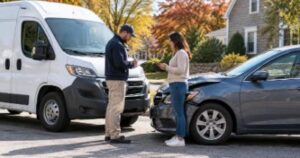
A delivery van, box truck, courier vehicle, restaurant delivery car, or app-based delivery vehicle may be connected to several businesses and insurance policies at the same time.
The driver may:
- Work directly for a delivery company
• Work for a local delivery contractor
• Make deliveries through an app
• Use a personal vehicle for business deliveries
• Drive a vehicle owned or leased by another company
• Follow routes, schedules, or delivery procedures set by another business
Because of these arrangements, identifying each potentially responsible party can be as important as proving who caused the crash.
If you need general information about Massachusetts car accident claims, visit:
https://www.lawhoey.com/massachusetts-car-accident-lawyer/
The Delivery Driver May Be Liable for Negligent Driving
A delivery driver may be liable when careless driving causes a collision. Negligence can include:
- Speeding
• Following too closely
• Failing to yield
• Running a red light or stop sign
• Making an unsafe turn
• Backing without a clear view
• Driving while distracted
• Using a phone while driving
• Failing to keep a proper lookout
Delivery work can create added distractions. A driver may be checking navigation directions, looking for an address, reviewing delivery instructions, stopping frequently, or trying to complete an assigned route. Those job demands do not excuse unsafe driving.
Evidence such as a police report, witness statements, photographs, video, phone records, GPS data, and delivery records may help establish how the collision occurred.
When a Delivery Company or Employer May Be Liable
Massachusetts law can hold an employer vicariously liable for an employee’s negligence when the employee was acting within the scope of employment.
Massachusetts courts generally examine whether:
- The employee was doing the kind of work the employee was hired to perform
• The conduct occurred substantially within authorized time and space limits
• The employee was acting, at least in part, to serve the employer
For a delivery driver, work within the scope of employment may include transporting packages, following an assigned route, traveling between delivery stops, or returning to a distribution location. A purely personal trip can produce a different legal analysis.
This issue matters because the employer may have commercial automobile or liability insurance that applies to the crash. In a serious injury claim, identifying every applicable policy can affect the compensation that may be available.
Employee or Independent Contractor?
Some delivery companies use employees. Others rely on independent contractors, delivery service partners, local contractors, or app-based workers. A written agreement describing a driver as an independent contractor does not always resolve every legal issue.
The facts can include:
- Who controls the driver’s work
• Who sets routes or delivery procedures
• Who provides training
• Who determines work schedules
• Who provides or controls the vehicle
• What performance standards apply
• What safety requirements the driver must follow
• How the driver is paid
• How the parties describe and structure their working relationship
A company can also face a claim based on its own conduct when the evidence supports one. Examples can include negligent hiring, supervision, training, scheduling, or vehicle maintenance.
The exact legal analysis depends on the relationship between the driver and the business involved.
Can the Vehicle Owner Be Responsible?
Vehicle ownership can affect a Massachusetts delivery driver accident claim.
Massachusetts General Laws Chapter 231, Section 85A states that proof that a motor vehicle was registered in a defendant owner’s name is prima facie evidence that the vehicle was being operated by someone for whose conduct the owner was legally responsible. The defendant can raise and prove an affirmative defense.
You can review the statute here:
https://malegislature.gov/Laws/GeneralLaws/PartIII/TitleII/Chapter231/Section85A
This rule can matter when a delivery driver is operating a company van or fleet vehicle. Ownership records can identify parties and insurance coverage that deserve investigation.
A leased or rented vehicle may involve separate legal rules, including federal law that can limit certain claims based only on vehicle ownership. The facts should be reviewed before responsibility is assigned to a leasing or rental company.
If defective brakes, worn tires, faulty steering, poor maintenance, or another vehicle condition contributed to the crash, records from the owner, fleet operator, repair shop, or maintenance contractor may also become relevant.
Other Parties May Share Responsibility
The driver and employer are not always the only possible defendants. Depending on what caused the crash, responsibility may also involve:
- A contractor that supervised or controlled the driver
• A business that improperly loaded or secured cargo
• A maintenance provider that performed defective repairs
• A manufacturer responsible for a defective vehicle or component
• Another motorist whose conduct contributed to the collision
• A vehicle owner whose legal responsibility is supported by the evidence
For example, a delivery van traveling through North Reading, Massachusetts, may collide with another vehicle that enters its lane. If the delivery driver was speeding and the other motorist failed to yield, both drivers may be examined. Fault depends on the evidence, not simply on the type of vehicle involved.
How Massachusetts Comparative Negligence Works
Massachusetts follows a modified comparative negligence rule.
Under Massachusetts General Laws Chapter 231, Section 85, you can recover damages if your negligence is not greater than the combined negligence of the person or people from whom you seek recovery. Any damages awarded are reduced according to your percentage of fault.
You can review the statute here:
https://malegislature.gov/Laws/GeneralLaws/PartIII/TitleII/Chapter231/Section85
For example, if you are found 20 percent responsible and the defendants are found 80 percent responsible, your damages are reduced by 20 percent. If your share of fault is greater than 50 percent, recovery is generally barred under this rule.
Comparative negligence can become especially relevant when several drivers or businesses may have contributed to the same crash.
Insurance Issues After a Delivery Driver Crash
Massachusetts uses a no-fault automobile insurance system. Personal Injury Protection, commonly called PIP, can pay covered medical expenses, up to 75 percent of lost wages, and certain replacement services without regard to fault, subject to statutory rules, policy terms, deductibles, and coordination with health insurance.
Massachusetts law provides PIP benefits up to a limit of $8,000 per person for covered losses.
You can review Massachusetts PIP information here:
https://www.mass.gov/info-details/part-ii-what-is-in-my-insurance-policy
The governing statutory definition is available here:
https://malegislature.gov/Laws/GeneralLaws/PartI/TitleXIV/Chapter90/Section34A
A delivery driver crash can involve more than PIP. Potential coverage may include:
- The delivery driver’s automobile liability policy
• A commercial automobile policy issued to an employer
• Insurance maintained by a delivery contractor
• Coverage connected to the vehicle owner
• Coverage maintained by another responsible business
• Coverage that applies to an app-based delivery driver during a particular stage of a delivery
If an app-based driver was using a personal vehicle, the driver’s status and activity at the time of the crash may affect which policy applies. The specific platform, policy language, and facts should be reviewed rather than assumed.
When Can You Recover Pain and Suffering Damages?
Massachusetts places a threshold on pain and suffering damages in many motor vehicle injury cases.
Under Massachusetts General Laws Chapter 231, Section 6D, a person generally must have more than $2,000 in reasonable and necessary medical expenses before recovering damages for pain and suffering, unless a statutory exception applies.
Exceptions include injuries involving:
- Death
• Loss of a body member
• Permanent and serious disfigurement
• Certain qualifying losses of sight or hearing
• A fracture
You can review the statute here:
https://malegislature.gov/Laws/GeneralLaws/PartIII/TitleII/Chapter231/Section6D
Whether the threshold applies to your claim depends on the injuries and facts involved.
Evidence That Can Make a Difference
Delivery accident cases can involve records that are not usually present in a standard two-car collision.
Evidence may include:
- GPS and route information
• Delivery scans and timestamps
• Dispatch messages
• App activity
• Dash camera or vehicle camera footage
• Driver schedules
• Driver training records
• Phone records
• Vehicle inspection records
• Vehicle maintenance and repair records
• Contracts between delivery companies and contractors
• Employment or contractor records
• Commercial insurance policies
• Photographs of the vehicles and scene
• Witness statements
• Police reports
Some electronic information and video can be deleted or overwritten through routine business practices. Early investigation can help identify records that should be preserved.
You can learn more about the attorneys at Hoey Law here:
https://www.lawhoey.com/our-team/
You can review prior case results here:
https://www.lawhoey.com/results/
Past results do not predict the outcome of any future case.
What Compensation May Be Available?
If another person or business is legally responsible for your injuries, compensation may be available for losses caused by the crash.
Depending on the facts, damages can include:
- Medical expenses
• Future medical care
• Lost wages
• Reduced earning capacity
• Pain and suffering when Massachusetts law permits recovery
• Disability
• Scarring or disfigurement
• Property damage
• Other documented accident-related losses
The value of a claim depends on factors such as the nature and duration of your injuries, liability evidence, available insurance, medical treatment, future care needs, income loss, and the effect of the injuries on your life.
No single formula determines the value of every delivery driver accident claim.
What Should You Do After a Delivery Driver Accident?
If you are involved in a delivery driver crash, your immediate priorities should be your health, safety, and documentation of what occurred.
When appropriate, consider these steps:
- Call 911 and report the collision to law enforcement
• Seek medical care for injuries or symptoms
• Take photographs and video if you can do so safely
• Exchange insurance and contact information
• Record the delivery company name shown on the vehicle
• Photograph the vehicle number, license plate, logos, and delivery markings
• Ask for the driver’s employer or contractor information
• Identify witnesses and save their contact information
• Preserve photographs, video, receipts, and other records in your possession
• Keep records of medical treatment and missed work
Do not assume that the insurance information provided at the scene identifies every policy that may apply. A delivery vehicle may be connected to an employer, contractor, owner, platform, or commercial insurer that is not obvious from the initial exchange of information.
For more Massachusetts injury information, visit:
How Long Do You Have to File a Delivery Driver Accident Claim?
Massachusetts General Laws Chapter 260, Section 2A generally requires tort actions, including many personal injury lawsuits, to be filed within three years after the cause of action accrues.
You can review the statute here:
https://malegislature.gov/Laws/GeneralLaws/PartIII/TitleV/Chapter260/Section2A
Some claims can involve different deadlines, notice requirements, parties, or accrual rules. The filing period should be evaluated using the facts of the specific case.
Delay can also create evidence problems before the legal deadline arrives. Video may be overwritten, vehicles may be repaired, witnesses may become harder to locate, and electronic delivery records may become more difficult to obtain.
Talk With a Massachusetts Delivery Driver Accident Attorney
If you were injured when a delivery driver caused a crash in Massachusetts, Hoey Law can review the circumstances, identify potentially responsible parties, examine available insurance, and explain the legal options that may apply.
Hoey Law has handled complex civil litigation and serious injury matters for decades from its North Reading office. The firm represents individuals and families in Massachusetts and beyond.
Call (978) 662-8868 or visit:
https://www.lawhoey.com/contact-us/
This article is for general informational purposes only and is not legal advice. Every case depends on its own facts and applicable law. Speak with an attorney about your specific situation.